
PolyHIPEs: High-Porosity Polymers through Emulsion Templating
Porous polymers are essential for catalysis, chromatography, separation, absorption, ion exchange, insulation, tissue engineering, drug delivery, and energy damping applications, to name but a few. PolyHIPEs (PHs) are novel, high-porosity polymer monoliths with unique porous structures that are typically templated within water-in-oil (w/o) high internal phase emulsions (HIPEs) and synthesized using free radical polymerization. These w/o HIPEs typically consist of an external (continuous) phase (monomers, crosslinking comonomers, and emulsifier) and from 74 % to over 90 % internal (dispersed) phase (water and a stabilizing salt). The internal phase can be removed through holes within the thin polymer film that surrounds the discrete internal phase droplets, leaving a highly interconnected, high-porosity, void structure (average diameters range from 10 to 100 µm). Similarly, Hydrogel PHs (HG-PHs) are novel, high-porosity hydrogel monoliths with unique porous structures that are typically templated within oil-in-water (o/w) HIPEs and synthesized using free radical polymerization. These o/w HIPEs typically consist of an external (continuous) phase (water, monomers, crosslinking comonomers, and emulsifier) and from an internal (dispersed) phase (organic liquid). The advantages of PHs and HG-PHs include their low densities (as low as 0.03 g/cm3), their ability to absorb large amounts of liquid (typically 9 g/g), and their flow-through capabilities.
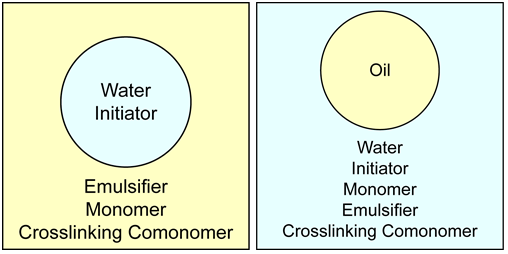
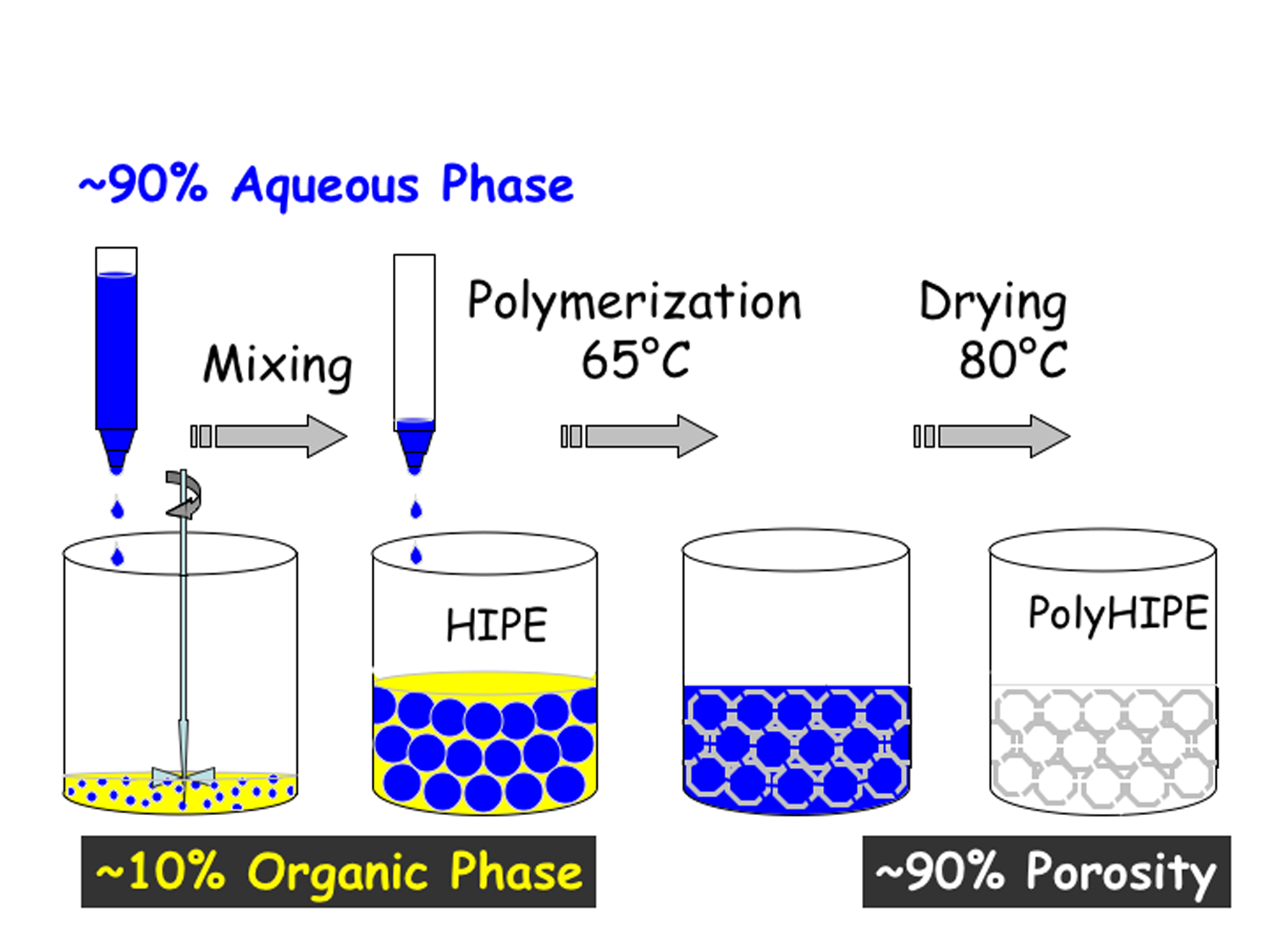
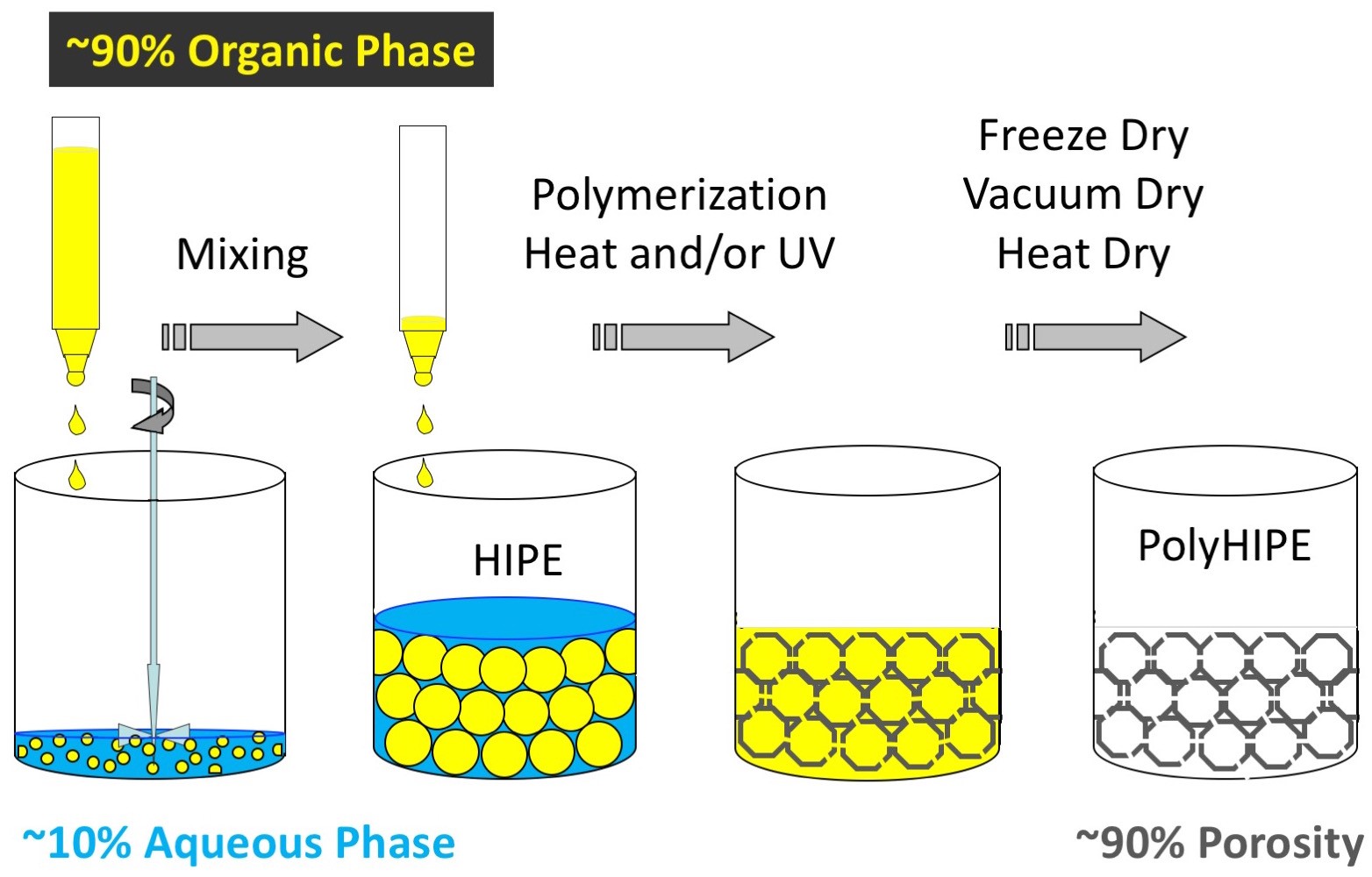
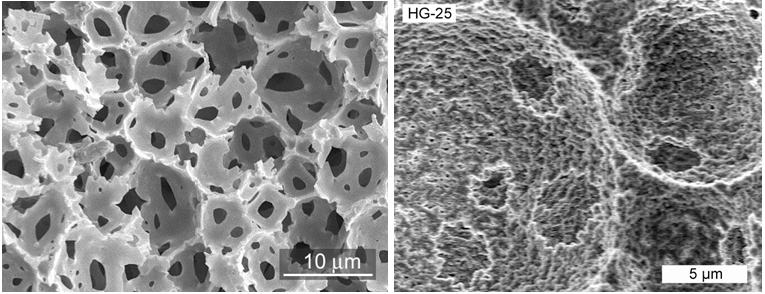
(90 % internal phase, styrene/divinylbenzene = 9/1).
PolyHIPE Topics
Shape memory PHs
Poly(urethane urea) PHs for tissue engineering
Hydrophobic-hydrophilic bicontinuous PHs for controlled release
Encapsulation of individual aqueous solution droplets
Encapsulation of individual molten salt droplets
Hydrogel PHs (HG-PHs) from oil-in-water HIPEs
Hydrophobic-hydrophilic bicontinuous PHs for toughening
We have developed organic-inorganic hybrid and nanocomposite polyHIPE. Silsesquioxane-based nanocomposites were synthesized using in-situ formation of silsesquioxane (SSQ) networks and through pre-formed SSQ. SSQ can have the molecular formula Rx-(SiO1.5)z-Ry (where x + y = z). The effect of pre-formed SSQ reactivity was also investigated. These nanocomposites exhibited superior mechanical properties and thermal stability. We have definitively demonstrated the relative importance of cross-linking, inorganic reinforcement, and covalent bonding to such nanocomposites. In addition, we have shows that highly porous inorganic monoliths could be produced through the pyrolysis of these porous polymer nanocomposites.


Other novel polyHIPE systems under development include hydrogel and bicontinuous polyHIPE for drug delivery, biodegradable polyHIPE for tissue engineering, conducting polyHIPE for sensors, crystallizable polyHIPE for shape memory, and interpenetrating polymer network polyHIPE. A recent discovery was the critical effect that the locus of initiation (organic phase or interface) has on the molecular structures, porous structure, and properties of polyHIPE.


Phase composition and porous structure of a bicontinuous polyHIPE. The hydrophobic scaffold is filled with a hydrogel.

Phase composition, molecular structure, and porous structure in a biodegradable polyHIPE.